logo

szczegółowe informacje o produktach

Created with Pixso. Do domu Created with Pixso. produkty Created with Pixso.
Izolacja wibracji z liny drutowej
Created with Pixso.

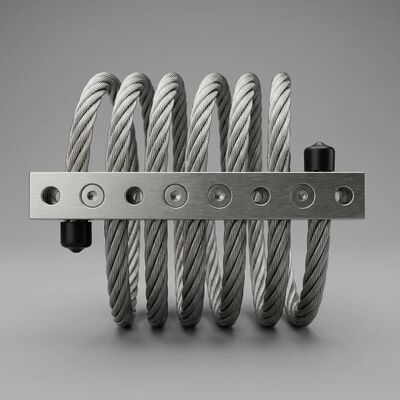
JGX-1276D-233B Wire Rope Vibration Isolator Infinite Service Life No Aging Cracking Material Degradation 233kg

JGX-1276D-233B Wire Rope Vibration Isolator Infinite Service Life No Aging Cracking Material Degradation 233kg

Nazwa marki: Hoan
Numer modelu: JGX-1276D-233B
MOQ: 4 sztuki
Warunki płatności: L/C, D/A, D/P, T/T, Western Union
Informacje szczegółowe
Miejsce pochodzenia:
Shaanxi, Chiny
Orzecznictwo:
ISO 9001:2015
Numer modelu:
JGX-1276D-233B
Materiał liny drutu:
Stal nierdzewna 316L (elektropolerowana)
Drutowa średnica liny:
12,7 mm
Liczba cewek:
6
Maksymalne obciążenie statyczne:
233 kg na uchwyt
Dynamiczna nośność:
100-120 kg na uchwyt
Oczekiwany okres użytkowania:
Ponad 30 lat w normalnym środowisku przemysłowym
Degradacja materiału:
Brak (całkowicie metalowy, bez składników organicznych)
Wymagana konserwacja:
Brak (bez smarowania, bez regulacji, bez cyklu przeglądu)
Temperatura pracy:
-70 ° C do +260 ° C.
Odporność na korozję:
Ponad 1000 godzin działania mgły solnej zgodnie z ASTM B117
Podkreślić:

Infinite Service Life Isolator Mount

,

No Aging Cracking Wire Rope Damper

,

Zero Degradation Vibration Isolator

Opis produktu

JGX-1276D-233B Wire Rope Vibration Isolator: Virtually Infinite Service Life, Zero Material Degradation

The JGX-1276D-233B represents the ultimate expression of the all-metal vibration isolation philosophy: a mounting solution engineered to perform identically on the day it is installed and thirty years later—with no aging, no cracking, no creep, and no degradation whatsoever. Built around 12.7 mm diameter electropolished 316L stainless steel wire rope formed into 6 precision coils and rated for 233 kg maximum static load, this isolator eliminates the single greatest weakness of traditional vibration mounts: the inevitability of material failure over time.

The Fundamental Problem with Conventional Vibration Mounts

Every vibration mount that contains organic materials—rubber, neoprene, polyurethane, silicone, or any elastomer—follows a predictable degradation lifecycle:

  • Phase 1 (0-2 years): The mount performs as designed. However, environmental factors have already begun their attack: UV radiation severs polymer chains at the surface; ozone attacks unsaturated bonds in the rubber backbone; plasticizers begin their slow migration toward the surface.
  • Phase 2 (2-5 years): Measurable changes appear. The elastomer stiffens as plasticizers evaporate and cross-linking density increases. Surface micro-cracks form, providing pathways for moisture and chemicals to penetrate deeper into the material. Damping characteristics drift from design specifications.
  • Phase 3 (5-10 years): Visible degradation is evident. Cracks propagate from the surface into the load-bearing core. The mount's stiffness may have changed by 30-50% from its original value. Dynamic performance is now substantially different from what was specified at installation. Replacement becomes necessary—requiring equipment shutdown, labor, and disposal costs.

The JGX-1276D-233B eliminates all three phases. With zero organic materials, there is simply nothing to age, nothing to crack, and no degradation mechanism to initiate.

Why the JGX-1276D-233B Achieves Infinite Service Life

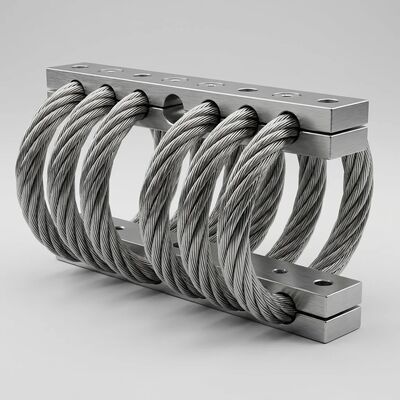
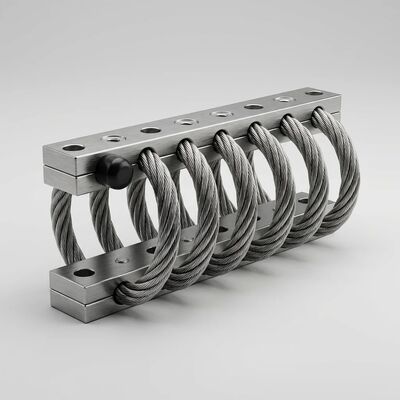
  • 100% Inorganic Construction: The load-bearing element is stranded 316L stainless steel wire rope. The clamping mechanism uses either stainless steel or aluminum alloy retaining bars. There are no polymers, no adhesives, no coatings that can degrade, and no fillers that can migrate. The isolator is, in the most literal sense, a purely metallic structure.
  • Friction Damping Without Wear: The damping mechanism relies on inter-strand Coulomb friction within the wire rope. Unlike hydraulic dampers that suffer seal wear and fluid degradation, or viscoelastic dampers that experience molecular-level fatigue, wire rope friction damping has no consumable components. The strands polish each other slightly during initial run-in and then stabilize into a steady-state condition that persists indefinitely.
  • Corrosion Barrier Through Electropolishing: The 316L wire rope undergoes electropolishing—an electrochemical process that removes surface irregularities at the microscopic level, eliminates embedded contaminants, and creates a chromium-enriched passive layer. The resulting surface resists corrosion initiation even in chloride-rich environments, achieving 1000+ hours of salt spray resistance per ASTM B117.
  • No Creep Under Sustained Load: Creep—the gradual permanent deformation under constant stress—is a failure mode unique to polymers and low-melting-point metals. Stainless steel wire rope at room temperature operates at a homologous temperature (T/T_melt) below 0.2, a regime where creep is metallurgically impossible. The isolator maintains its exact geometry regardless of how long the load is applied.
  • No Fatigue Limit Concerns in the Load Range: While all metals have a fatigue limit, the JGX-1276D-233B operates well below the endurance limit of 316L stainless steel. Under normal vibration amplitudes, the cyclic stress experienced by individual wire strands is orders of magnitude below the material's fatigue threshold, meaning fatigue crack initiation is not a credible failure mode within the isolator's design life.

Technical Specifications

Parameter Specification
Model Number JGX-1276D-233B
Wire Rope Material Stainless Steel 316L (Electropolished)
Wire Rope Diameter 12.7 mm
Number of Coils 6
Max Static Load 233 kg per mount
Dynamic Load Capacity 100-120 kg per mount
Expected Service Life 30+ years (normal industrial environment)
Material Degradation Mechanism None identified (all-metal construction)
Maintenance Requirement Zero scheduled maintenance
Corrosion Resistance 1000+ hours salt spray (ASTM B117)
Operating Temperature -70°C to +260°C
Certification ISO 9001:2015

Mounting Bars: Configuration Guide

The retaining bars that clamp the wire rope helix to your equipment are available in two materials, each with distinct advantages:

Material Selection:

  • Stainless Steel Retaining Bars: Provide the ultimate in corrosion immunity and clamping force stability. When the entire isolator—wire rope and bars alike—is stainless steel, the assembly is completely impervious to galvanic corrosion and delivers identical clamping force decade after decade. This is the recommended configuration for marine, offshore, chemical processing, and outdoor installations.
  • Aluminum Alloy 6061-T6 Retaining Bars: Reduce isolator weight by approximately 40% compared to stainless steel bars while maintaining sufficient strength for the rated load. This option is preferred for weight-critical applications such as aerial platforms, mobile equipment, and transportable systems.

Surface Treatment for Aluminum Bars:

  • White Anodizing: Standard treatment that increases surface hardness beyond that of bare aluminum while preserving a clean metallic appearance. Suitable for indoor industrial environments, machinery rooms, and protected installations.
  • Hard Anodizing: Creates a substantially thicker oxide layer with superior abrasion resistance and a darker gray appearance. Recommended for installations in abrasive environments—mining operations, cement plants, quarries—or where the isolators may experience incidental mechanical contact during routine equipment servicing.

Key Characteristics of WNRLN Wire Rope Isolators

  • Absolutely no creep, aging, or material fatigue over the full service life
  • High internal damping coefficient achieved purely through metallic friction—no fluids, gases, or viscoelastic materials
  • Consistent performance across extreme temperature range from -70°C to +260°C
  • Flexible mounting configurations with multiple fitting and orientation options
  • Fast prototyping turnaround for custom dimensions, load ratings, and mounting patterns
  • Rugged all-metal construction engineered for decades of continuous service
  • Simultaneous shock and vibration attenuation in compression, tension, and shear/roll
  • Complete immunity to chemical agents, salt water, ozone, ultraviolet radiation, and industrial cleaning compounds

Applications Where Service Life Determines Total Cost

The JGX-1276D-233B's infinite service life creates disproportionate value in applications where access is difficult, downtime is expensive, or replacement logistics are prohibitive:

  • Remote and Unmanned Installations: Telecommunications relay stations on mountain peaks, offshore platform equipment rooms, desert solar farm inverters, and Arctic research station generators all share a common challenge: sending a technician to replace a failed vibration mount costs orders of magnitude more than the mount itself. The JGX-1276D-233B's fit-and-forget nature eliminates these intervention costs entirely.
  • Continuous Process Industries: In chemical plants, oil refineries, cement kilns, and steel mills, an unplanned shutdown to replace failed equipment mounts can cost hundreds of thousands of dollars per day in lost production. Installing mounts that never require replacement converts a recurring operational risk into a one-time capital decision.
  • Embedded and Inaccessible Equipment: Vibration isolators installed inside sealed enclosures, beneath cast-in-place machinery, or within building structural elements cannot be economically replaced. In such installations, the isolator's service life becomes the equipment's service life—making degradation-free construction an absolute requirement.
  • High-Value Rotating Machinery: Large centrifugal compressors, gas turbines, and process pumps represent multi-million-dollar capital investments. The cost of isolator replacement is trivial compared to the cost of bearing damage, seal failure, or rotor imbalance caused by degraded mounts that no longer provide specified vibration isolation performance.
  • Transportation Infrastructure: Bridge bearing pads, railway track isolation systems, and tunnel ventilation fan mounts are expected to serve for the 50-100 year design life of the infrastructure itself. Only all-metal isolators can credibly make this commitment without relying on assumptions about polymer aging that cannot be validated over such timescales.

Total Cost of Ownership Analysis

Consider a typical industrial installation requiring 16 vibration isolators, each rated for 200+ kg:

Cost Element (25-Year Period) Elastomeric Mounts JGX-1276D-233B
Initial Procurement (16 units) $800 $2,400
Scheduled Replacements (every 7 years x3) $2,400 $0
Replacement Labor (4 hours x 3 cycles x $150/hr) $1,800 $0
Production Downtime (8 hrs x 3 cycles x $2,000/hr) $48,000 $0
Disposal and Environmental Fees $400 $0
Total 25-Year Cost $53,400 $2,400
Cost Ratio 22:1 Baseline

Note: This analysis assumes accessible equipment in a developed market. For remote installations, the cost ratio can exceed 100:1.

Environmental Resistance Beyond Aging

The absence of organic materials also confers resistance to a broad spectrum of environmental stressors that accelerate aging in conventional mounts:

  • UV Radiation: A non-issue for stainless steel. There are no polymer chains to photodegrade, no colorants to fade, and no surface oxidation beyond the self-passivating chromium oxide layer that forms naturally on stainless steel.
  • Ozone: Ozone attack is one of the most aggressive degradation mechanisms for rubber, causing characteristic perpendicular cracking even in unstressed material. The JGX-1276D-233B has zero sensitivity to atmospheric ozone at any concentration.
  • Hydrolysis and Moisture: Polyurethane mounts are susceptible to hydrolysis when exposed to warm, humid conditions—a chemical reaction that breaks polymer chains and permanently reduces mechanical properties. Stainless steel experiences no such reaction with water in any form.
  • Chemical Exposure: Hydraulic fluid spills, lubricating oil mist, cleaning solvents, and industrial chemical vapors attack different elastomers in different ways—swelling one type while hardening another. The JGX-1276D-233B is compatible with virtually all industrial chemicals except strong reducing acids, and those only at elevated concentrations and temperatures.
  • Microbiological Attack: In tropical and subterranean installations, rubber components can be degraded by fungi, bacteria, and other microorganisms that metabolize organic polymer constituents. Stainless steel provides no nutritional substrate for biological growth.

Quality Assurance

Every JGX-1276D-233B is manufactured under ISO 9001:2015 certified quality management with full material traceability from raw wire rope coil to finished isolator. Each unit undergoes 100% dimensional inspection, and sample lots are subjected to accelerated corrosion testing per ASTM B117, cyclic load endurance testing, and transmissibility validation on an electrodynamic shaker table. Certificates of conformance and material test reports are available upon request.

Company Information

WNRLN is a specialized manufacturer of wire rope vibration isolators, shock mounts, and energy absorption solutions for demanding industrial and commercial applications. With deep expertise in all-metal isolation technology, we provide products that outlast the equipment they protect.

Our engineering capabilities span standard catalog products and fully customized solutions—from modified mounting patterns and load ratings to complete bespoke isolator designs for unique applications. With rapid prototyping facilities and an experienced technical team, we deliver custom samples within weeks, not months.

WNRLN products are trusted by equipment manufacturers, system integrators, and end users across industries including power generation, oil and gas, marine transportation, construction machinery, precision instrumentation, and telecommunications infrastructure. Our commitment to quality is backed by ISO 9001:2015 certification and a rigorous in-house testing program.

To discuss your vibration isolation requirements or request a comprehensive technical proposal, contact our application engineering team today. Provide your equipment specifications and operating environment for a tailored solution recommendation within 48 hours.

Contact our engineering team to discuss your application's service life requirements. We can provide a tailored total cost of ownership comparison for your specific equipment configuration and operating environment.