logo

szczegółowe informacje o produktach

Created with Pixso. Do domu Created with Pixso. produkty Created with Pixso.
Izolacja wibracji z liny drutowej
Created with Pixso.

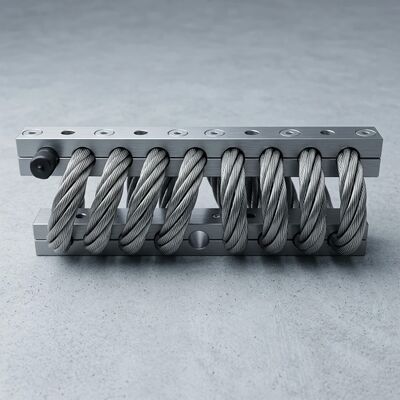
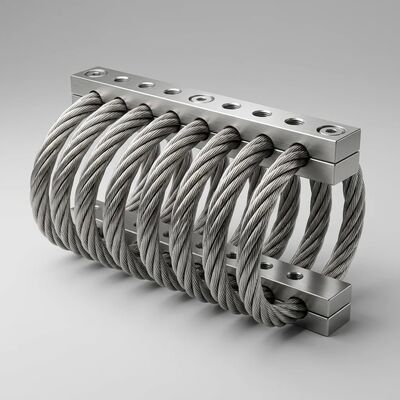
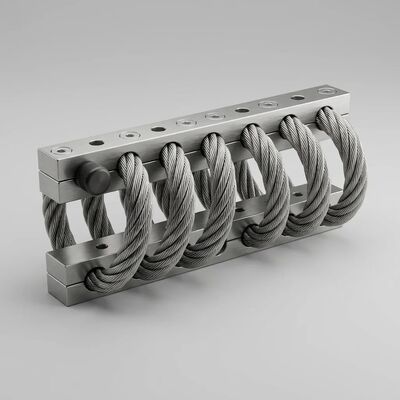
JGX-2228D-1250B Fail-Safe Vibration Control Wire Rope Isolator for Precision Deflection Management

JGX-2228D-1250B Fail-Safe Vibration Control Wire Rope Isolator for Precision Deflection Management

Nazwa marki: Hoan
Numer modelu: JGX-2228D-1250B
MOQ: 10 sztuk
Warunki płatności: L/C, D/A, D/P, T/T, Western Union
Informacje szczegółowe
Miejsce pochodzenia:
Shaanxi, Chiny
Orzecznictwo:
ISO 9001:2015, CE, RoHS
Numer modelu:
JGX-2228D-1250B
Tworzywo:
Lina stalowa ze stali nierdzewnej AISI 316L + zaciski ze stopu aluminium 6061-T6
Drutowa średnica liny:
8,0 mm (linka 7x19, 133 przewody)
Liczba cewek:
10 cewek (symetryczna podwójna spirala)
Wymiary całkowite (dł. x szer. x wys.):
210 mm x 120 mm x 95 mm
Waga na jednostkę:
3,20 kg
Średnica otworu montażowego:
12,5 mm (śruby M12)
Nośność statyczna:
100 kg - 1200 kg na uchwyt
Maksymalne ugięcie pod obciążeniem:
22 mm (oś kompresji)
Tolerancja ugięcia:
±3% jednostka do jednostki (zweryfikowana partia)
Szybkość sprężyny (statyczna):
45 N/mm - 545 N/mm (progresywna, charakterystyka 3-strefowa)
Częstotliwość naturalna:
4 Hz - 12 Hz
Współczynnik tłumienia:
0,15 - 0,25
Mechanizm tłumiący:
Tarcie kulombowskie (suche), 133 niezależne interfejsy przewodowe
Transmisyjność w rezonansie:
< 4:1 (typowo 1,5–3,5×)
Skuteczność izolacji przy 2× fn:
> 85%
Maksymalne wejście wstrząsu:
25 g (impuls półsinusoidalny 11 ms)
Stosunek sztywności dynamicznej do statycznej:
1,1 - 1,3
Zakres temperatur:
-40 ° C do +180 ° C.
Żywotność z powodu zmęczenia:
> 2x10⁶ cykli przy obciążeniu znamionowym
Obróbka powierzchniowa:
Lina stalowa polerowana elektrolitycznie (Ra ≤ 0,4 μm), zaciski anodowane na twardo (25 μm)
Podkreślić:

wire rope isolator fail-safe vibration control

,

precision deflection wire rope isolator

,

wire rope vibration isolator with warranty

Opis produktu

JGX-2228D-1250B Fail-Safe Vibration Control Wire Rope Isolator

In vibration engineering, there is a persistent trade-off between damping performance and predictability. Hydraulic dampers offer high, tunable damping coefficients but introduce fluid seals that leak, viscosity that shifts with temperature, and cavitation that creates non-linear force discontinuities. Elastomeric mounts are simple and inexpensive but exhibit stiffness and damping that drift with time, temperature, and strain history—making the isolation system's dynamic response a moving target. The JGX-2228D-1250B resolves this trade-off by anchoring its fail-safe vibration control in a physical mechanism that is simultaneously high-performing and inherently stable: Coulomb friction between steel wires.

The Damping Mechanism: 133 Friction Interfaces in Parallel

The JGX-2228D-1250B's 8.0 mm wire rope is constructed as a 7*19 strand—seven bundles, each containing nineteen individual AISI 316L steel wires, for a total of 133 filaments within a single rope cross-section. When the helix deforms under external vibration, adjacent wires within each strand bundle slide against one another at the microscopic scale. This inter-wire sliding converts kinetic (vibration) energy into heat through dry Coulomb friction.

Key characteristics of this damping mechanism:

  • Distributed redundancy: Damping force is generated across 133 parallel contact interfaces. No single interface contributes more than approximately 0.75% of the total damping capacity. Failure of any individual wire—a statistical near-impossibility within the fatigue limit—reduces total damping by less than 1%, preserving the fail-safe vibration control function.
  • Temperature insensitivity: The friction coefficient of 316L stainless steel on itself varies by less than 10% across the -40°C to +180°C operating range. In contrast, the viscosity of silicone damping fluid can change by a factor of 20 across the same span, rendering a fluid damper overdamped at cold start and underdamped at operating temperature.
  • Amplitude dependence (beneficial): At low vibration amplitudes (typical of normal rotating machinery operation), inter-wire slip is minimal and the isolator behaves as a predominantly elastic spring with low energy dissipation—preserving high transmissibility isolation efficiency. As amplitude increases (shock events, startup transients), slip engages progressively, raising the effective damping ratio from approximately 0.15 to 0.25 to absorb the larger energy input.
  • Zero degradation with age: Unlike viscoelastic polymers where the long-chain molecular network degrades through oxidation, chain scission, and cross-link density changes, the crystalline metallic structure of 316L steel does not evolve over time at temperatures below the recrystallization threshold (>500°C). The damping performance at year 15 is, for all practical purposes, identical to the damping performance on day 1.

Precision Deflection: ±3% Unit-to-Unit, 100% Tested

Precision deflection control is the engineering discipline of ensuring that when a specific static load is applied, the resulting displacement is predictable—not just from the design equations, but from the actual manufactured unit in the user's hand. The JGX-2228D-1250B achieves ±3% unit-to-unit static deflection variation, verified on every single unit before serialization.

Why this tolerance matters in multi-point mounting systems:

Consider a 2,400 kg compressor skid supported by four JGX-2228D-1250B mounts, each carrying 600 kg static load. At this load, the nominal static deflection is approximately 12 mm. With ±3% tolerance, the worst-case deflection spread across the four mounts is 11.64 mm to 12.36 mm—a maximum mount-to-mount height difference of 0.72 mm. Across a typical 800 mm mount spacing, this produces an angular tilt of approximately 0.05°, which is within the alignment tolerance of nearly all standard flexible shaft couplings (typically 0.25°–1.0° depending on coupling type). The coupling is not the limiting factor; the mounts are precise enough to preserve coupling alignment without shimming.

The manufacturing processes that deliver this consistency:

  • CNC wire rope coiling: Closed-loop tension control during helix forming maintains consistent coil geometry within ±0.3 mm pitch variation.
  • Precision clamp block machining: The rope-capture pockets in the 6061-T6 clamp blocks are CNC-machined to ±0.02 mm dimensional tolerance, ensuring uniform circumferential grip pressure on the rope at both ends.
  • 100% load-deflection curve verification: Every serialized unit is mounted on a calibrated servo-hydraulic test stand and subjected to a load ramp from zero to 1,300 kg while deflection is measured by a laser displacement sensor with 0.01 mm resolution. The resulting curve is digitally compared to the master reference; units exceeding the ±3% deflection band are automatically rejected and quarantined for root-cause investigation.
  • Statistical process control: Batch-level deflection data is tracked in control charts. Shifts in mean deflection or increases in variance trigger pre-out-of-spec process adjustments before non-conforming units are produced.

Three-Zone Stiffness: Soft at Cruise, Stiff at Impact

The static spring rate of the JGX-2228D-1250B is not a single number; it is a curve with three distinct zones determined by the physical state of the wire rope helix under progressive loading:

Zone Load Range Stiffness Helix State Design Purpose
I: Elastic Bending 100–300 kg ~45–90 N/mm Coils deform elastically; individual wires bend but do not compact Maximize isolation for light equipment and small-amplitude continuous vibration
II: Strand Compaction 300–800 kg ~90–270 N/mm Wires within each strand compact together; inter-wire friction increases progressively Smooth transition from soft isolation to load-bearing with increasing damping
III: Geometric Stiffening 800–1,200 kg ~270–545 N/mm Helix geometry approaches full compaction; coil-to-coil spacing minimizes Limit deflection to 22 mm under shock/overload without external travel stops

This progressive curve is the isolator's most valuable dynamic characteristic. During normal operation in Zone I or II, the low dynamic stiffness provides high isolation efficiency—greater than 85% of vibration energy is blocked at frequencies above 1.4* the natural frequency. When a shock event or startup torque transient drives the mount into Zone III, the sudden stiffness increase limits displacement to 22 mm maximum without metal-to-metal contact, fluid bottoming, or elastomer crushing. There are no external snubbers to adjust, no clearance gaps to set, and no supplemental springs to tune. The single helical element handles the full dynamic range.

Dynamic Performance Data

Parameter Value Test Method
Transmissibility at Resonance < 4:1 (1.5–3.5* typical) Swept-sine base excitation, 2–50 Hz, 0.5g input
Isolation Efficiency @ 1.4* fn > 60% Force transmissibility measurement
Isolation Efficiency @ 2* fn > 85% Force transmissibility measurement
Maximum Shock Input 25g, 11 ms Half-Sine IEC 60068-2-27, 3 pulses per axis
Dynamic/Static Stiffness Ratio 1.1–1.3 Dynamic stiffness @ 0.5 mm amplitude, 5–20 Hz
Fatigue Life (S-N) > 2 * 10² cycles @ ±0.5 mm amplitude Constant-amplitude sinusoidal, 10 Hz, rated static preload
Damping Ratio Stability < ±5% deviation over 10² cycles Periodic damping measurement during fatigue test

Technical Specifications

Parameter Value
Model JGX-2228D-1250B
Wire Rope AISI 316L Stainless Steel, 8.0 mm Ø, 7*19 (133 Wires)
Clamp Material 6061-T6 Aluminum Alloy, Hard Anodized 25 μm
Coil Configuration 10 Coils, Symmetrical Double-Helix
Dimensions 210 mm (L) * 120 mm (W) * 95 mm (H)
Mass 3.20 kg
Mounting 4* Ø12.5 mm Through-Holes, Accept M12 Fasteners
Static Load Range 100–1,200 kg per Mount
Max Deflection 22 mm (Compression Axis at Rated Load)
Deflection Tolerance ±3% Unit-to-Unit (100% Verified)
Static Spring Rate 45–545 N/mm (Progressive, 3-Zone)
Natural Frequency 4–12 Hz (Load-Dependent)
Damping Ratio ζ = 0.15–0.25
Damping Type Coulomb (Dry) Friction, 133 Parallel Interfaces
Transmissibility @ fn < 4:1 (1.5–3.5* typical)
Isolation Efficiency @ 2* fn > 85%
Max Shock Input 25g (11 ms Half-Sine, 3 Pulses per Axis)
Dynamic/Static Stiffness 1.1–1.3 (0.5 mm Amplitude, 5–20 Hz)
Operating Temperature -40°C to +180°C (Continuous)
Fatigue Life > 2 * 10² Cycles at Rated Static Load
Surface Finish Wire Rope: Electropolished Ra ≤ 0.4 μm; Clamps: Anodized 25 μm
Certifications ISO 9001:2015, CE, RoHS, REACH

Precision-Critical Applications

  • CNC Machining Centers & Grinding Machines: Machine tool geometric accuracy depends on the foundation maintaining level to within arc-seconds. The ±3% mount deflection tolerance ensures the machine bed does not tilt progressively as mounts settle, preserving the volumetric positioning accuracy verified during factory acceptance testing.
  • Coordinate Measuring Machines (CMM): Metrology laboratory equipment with sub-micron measurement uncertainty cannot tolerate mount drift between calibration intervals. The zero-creep characteristic of the all-metal JGX-2228D-1250B eliminates the slow progressive sag (μm/month) typical of elastomeric mounts under continuous static load, preserving the CMM's spatial calibration without re-shimming.
  • Precision Balancing Machines: Dynamic balancing of turbine rotors, crankshafts, and high-speed spindles requires the balancing machine itself to be isolated from floor vibration while remaining rigidly positioned. The progressive stiffness curve provides isolation during the balance measurement phase (low-amplitude input) while resisting displacement from the rotor's unbalance forces during spin-up.
  • Semiconductor Lithography & Inspection Tools: Wafer steppers and electron-beam inspection systems in semiconductor fabs operate with positioning tolerances measured in nanometers. The all-metal construction eliminates the outgassing of plasticizers and volatile organic compounds (VOCs) from elastomeric mounts that can condense on optical surfaces, while the precision deflection tolerance preserves the tool's alignment with the facility's vibration-isolated sub-floor.
  • Laser Interferometer & Optics Tables: Research-grade optical experiments with multi-day measurement campaigns require mounts that do not drift during the experiment. The JGX-2228D-1250B's all-metal, zero-creep architecture eliminates the slow height change that would progressively misalign beam paths over hours or days.
  • High-Speed Packaging & Printing Machinery: Flexographic printing presses and high-cycle cartoning machines generate repetitive shock at 200–600 cycles per minute. The 2-million-cycle fatigue rating at rated load ensures service intervals measured in years, not months, in continuous 3-shift production environments.

The Dynamic-to-Static Stiffness Ratio: Why 1.1–1.3 Matters

Most elastomeric isolators have a dynamic-to-static stiffness ratio of 1.5–2.5, meaning the mount is 50–150% stiffer under vibration than under static load. This complicates isolation system design because the natural frequency during operation (which determines isolation effectiveness) is higher than the simple static calculation predicts. The JGX-2228D-1250B's ratio of 1.1–1.3 is among the lowest achievable without active control, because Coulomb friction between metallic surfaces exhibits far less strain-rate sensitivity than the viscoelastic deformation of rubber polymers. When an engineer calculates the natural frequency from the static load-deflection curve, the operating natural frequency will be within approximately 5–15% of the predicted value—an accurate starting point rather than a coarse estimate.

Factory Documentation Package

Each JGX-2228D-1250B is supplied with its individual load-deflection test curve (digital or printed, per customer preference), the 316L heat certificate per EN 10204 3.1, the 6061-T6 billet certificate, and the anodizing batch log. All documents are keyed to the laser-etched serial number on the clamp body. This documentation set supports regulatory compliance audits, customer incoming inspection, and equipment qualification programs in industries including power generation, oil and gas, and marine classification society approval processes.